
SEO for Startups: A Practical Guide to Growing Organic Traffic and Leads
Starting a new business is exciting, but getting your startup discovered online can be one of the biggest challenges. With established companies already competing for visibility, startups need a smart and sustainable digital marketing strategy to reach potential customers. This is where SEO for startups becomes important.
Search engine optimization helps startups improve their visibility in search results, attract relevant organic traffic, build brand credibility, and generate qualified leads without depending entirely on paid advertising. However, effective startup SEO is not simply about adding keywords to a website. It requires a combination of keyword research, technical optimization, useful content, competitor analysis, authority building, and continuous improvement.
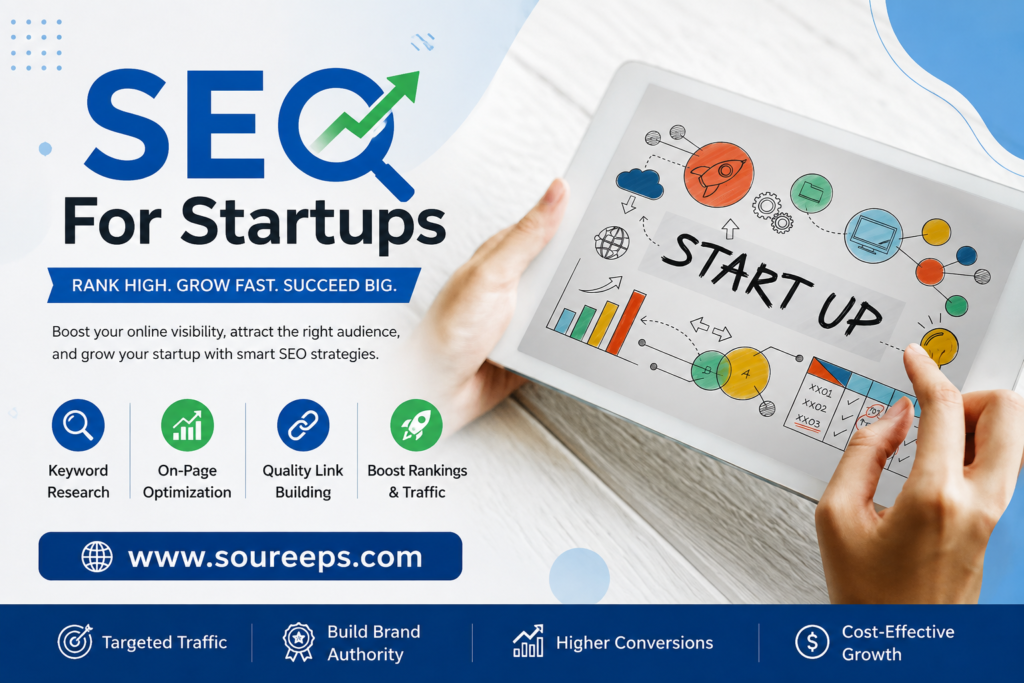
Understanding SEO for Startups
SEO for startups means optimizing a business website and its online presence so that search engines can better understand the business and connect it with people searching for relevant products, services, or information.
For an early-stage company, SEO can be particularly valuable because it creates an opportunity to compete for specific searches even when larger competitors have more resources and stronger domains. Instead of immediately targeting extremely competitive keywords, startups can focus on specific, high-intent searches that closely match their products and customer needs.
SEO should also be connected to business objectives. Ranking for keywords is useful, but generating qualified leads, product sign-ups, enquiries, sales, and revenue is ultimately more important.
Start With Keyword Research and Search Intent
Keyword research is one of the foundations of a successful startup SEO strategy. Before creating content, a startup should understand what its potential customers are searching for and why they are searching for it.
Broad keywords often have high search volume but can be extremely difficult to rank for. For a new website, targeting more specific long-tail keywords can provide better opportunities. For example, instead of targeting a highly competitive term such as “project management software,” a startup might target a more specific search such as “project management software for remote teams.”
The goal is not to find keywords with the highest possible search volume. The goal is to identify searches that are relevant to the business and have the potential to attract people who may eventually become customers.
Tools such as Google Keyword Planner, Ahrefs, and Semrush can help identify search volume, keyword difficulty, related terms, and competitor opportunities. However, keyword data should always be combined with an understanding of the customer and their problems.
Build an SEO-Friendly Website
A strong SEO strategy needs a solid technical foundation. Search engines must be able to crawl, understand, and index a startup’s website efficiently, while visitors should be able to navigate it easily.
A startup website should have a logical structure, simple URLs, clear navigation, mobile-friendly design, secure HTTPS implementation, and properly optimized pages. Important technical elements such as XML sitemaps, robots.txt, canonical URLs, redirects, and structured data should also be reviewed where appropriate.
Website performance matters as well. Large images, unnecessary scripts, poor hosting, and inefficient code can create a slow user experience. Improving page performance can make the website easier and more enjoyable to use, particularly for visitors browsing on mobile devices.
Technical SEO should not become an endless pursuit of perfect scores, however. The priority should be creating a website that is accessible, usable, crawlable, and fast enough to provide a good experience.
Create Content That Solves Real Problems
Content marketing is one of the most powerful components of SEO for startups. Instead of producing articles simply because they contain keywords, startups should create content that answers real questions and solves problems faced by their target audience.
This could include educational articles, detailed guides, product comparisons, case studies, tutorials, FAQs, industry research, use-case pages, and product-focused resources.
For example, a SaaS startup selling accounting software could create content around topics such as accounting challenges for small businesses, comparisons between accounting platforms, guides to automating invoices, and solutions to common bookkeeping problems.
The strongest content goes beyond basic explanations. It provides practical information, original insights, examples, data, experience, or a clear recommendation that helps readers make better decisions.
Build Topical Authority Through Content
Publishing random blog posts is unlikely to create a strong long-term SEO strategy. Startups should instead build topical depth around the subjects most closely connected to their products and expertise.
A central pillar page can cover a broad topic while supporting articles address specific questions and use cases. These pages can then be connected through strategic internal linking.
This structure helps users discover related information and gives search engines clearer context about the subjects the website covers.
For startups, this approach can also create a scalable content system. Instead of constantly searching for unrelated blog ideas, the business can build a library of resources around the problems its customers actually face.
Use Competitor Analysis to Find SEO Opportunities
Startups do not have to build their SEO strategy from scratch. Competitor analysis can reveal valuable information about what is already working in the market.
By analyzing competing websites, startups can identify keywords, content topics, comparison pages, backlinks, and search queries that may represent opportunities.
The objective should not be to copy competitors. Instead, identify weaknesses in existing search results and create something more useful, accurate, original, or relevant.
Competitor analysis can also reveal gaps. If competitors rank for an important topic but provide incomplete information, a startup may be able to create a substantially better resource and compete for the same audience.
Focus on High-Intent Searches
One of the biggest mistakes startups make is focusing exclusively on informational keywords. Informational content is useful for building awareness, but commercial and transactional searches can be much closer to revenue.
Someone searching for “what is CRM software” is at a different stage of the buying journey than someone searching for “best CRM software for small businesses” or “[competitor] alternatives.”
A successful startup SEO strategy should therefore cover different stages of the customer journey. Educational content can introduce the problem, comparison and alternative pages can help users evaluate solutions, while product and service pages can capture people who are ready to take action.
Strengthen On-Page SEO
Once content is created, every important page should be properly optimized. This includes writing descriptive title tags, useful meta descriptions, logical headings, clean URLs, relevant internal links, and naturally incorporating important terms throughout the content.
Images should also be properly compressed and given descriptive filenames and appropriate alternative text when needed.
On-page SEO should always support readability. Keywords should fit naturally into the content rather than being repeated unnecessarily. Modern SEO is not about keyword stuffing; it is about clearly communicating the topic and satisfying the searcher’s needs.
Earn High-Quality Backlinks and Brand Mentions
Backlinks remain an important part of building website authority, particularly for startups competing against established websites.
Rather than trying to acquire large numbers of low-quality links, startups should focus on earning relevant links from trustworthy websites. Original research, useful tools, industry studies, expert contributions, digital PR, partnerships, podcasts, webinars, and genuinely valuable resources can all create opportunities for natural mentions and links.
A strong content asset can sometimes attract links without direct outreach because other publishers find it useful as a reference.
The same principle applies to brand building. The more people discover, discuss, and reference a startup across the web, the stronger its overall online presence can become.
Local SEO for Startups
For startups serving a specific city or geographic area, local SEO can provide an additional source of qualified traffic.
A well-optimized Google Business Profile, consistent business information, genuine customer reviews, location-specific pages, and locally relevant content can help a business become more visible for searches with local intent.
For example, a startup providing professional services in Kolkata may benefit from creating useful content and service pages specifically relevant to customers searching for those services in Kolkata.
Local SEO should be treated as part of the broader marketing strategy rather than simply a directory-listing exercise.
SEO and Conversion Optimization Should Work Together
Generating organic traffic is only part of the process. A startup also needs to convert that traffic into meaningful business outcomes.
SEO landing pages should clearly communicate what the company offers and why it is valuable. Strong calls to action, simple enquiry forms, product demonstrations, customer testimonials, case studies, pricing information, and trust signals can help visitors take the next step.
This is why SEO and conversion rate optimization should work together. A page that attracts thousands of visitors but generates very few enquiries may not be as valuable as a smaller page that consistently attracts highly qualified prospects.
Measure What Actually Matters
SEO should be measured against business objectives rather than vanity metrics alone. Google Search Console and Google Analytics can provide valuable information about organic visibility, traffic, user behavior, and conversions.
Startups should monitor which pages attract organic visitors, which search queries generate impressions and clicks, which pages produce leads or sales, and where opportunities exist for improvement.
High-performing pages should also be reviewed regularly. Search trends change, competitors publish new content, and information becomes outdated. Updating successful content can help maintain its relevance and performance.
How AI Is Changing SEO for Startups
Artificial intelligence is changing how businesses approach SEO, but it is not making SEO irrelevant. AI tools can help startups accelerate keyword research, content planning, competitor analysis, data analysis, content outlines, and repetitive optimization tasks.
However, simply generating large amounts of AI-written content is not a sustainable SEO strategy. Search engines and users ultimately benefit from content that is useful, original, trustworthy, and relevant.
Startups should use AI as a productivity tool while adding human expertise, original research, first-hand experience, examples, opinions, and accurate information. The objective should be to create better resources, not simply more pages.
When Should a Startup Invest in SEO?
SEO is a long-term marketing channel, so startups should approach it with realistic expectations. Businesses still validating their product, audience, or positioning may want to focus first on understanding their customers and achieving product-market fit.
Once a startup has a clear target audience and a product or service that solves a real problem, SEO can become an increasingly valuable growth channel.
Early efforts should focus on building a technically sound website, creating useful content, targeting realistic keywords, and establishing a foundation of authority. As the business gains traction, the SEO strategy can expand into more competitive keywords, larger content clusters, digital PR, link acquisition, and broader market opportunities.
Final Thoughts on SEO for Startups
SEO for startups is not about finding a shortcut to the top of Google. It is about building a sustainable system that connects the right audience with the right solution.
A successful strategy combines keyword research, search intent, technical SEO, high-quality content, topical authority, competitor research, internal linking, backlinks, local SEO, conversion optimization, analytics, and continuous improvement.
The startups most likely to succeed with SEO are those that focus less on manipulating search engines and more on understanding their customers. Create content that genuinely helps people, build a website that is easy to use, demonstrate real expertise, and consistently improve the experience.
With the right strategy and patience, organic search can become a valuable long-term source of visibility, qualified leads, customers, and sustainable startup growth.